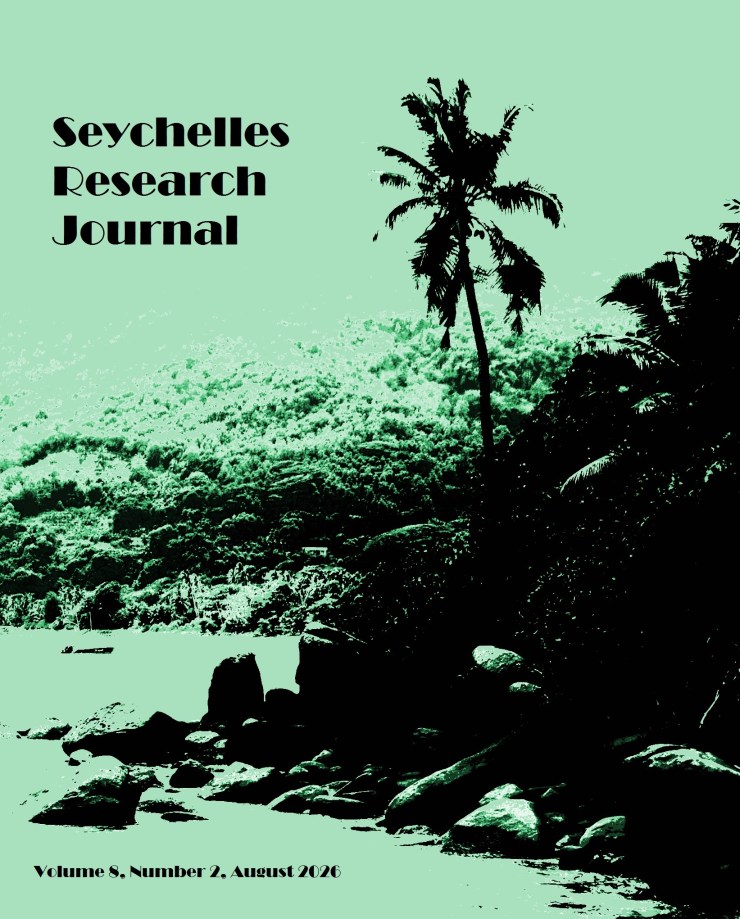
JOURNAL INFORMATION
Seychelles Research Journal is published twice a year, in February and August. The aim of this online, open access journal is to demonstrate the vibrancy of research in and about Seychelles. Boundaries are drawn loosely to include comparable issues elsewhere in the western Indian Ocean and in small island states further afield.
Information on how to submit proposed articles and on the refereeing process is explained elsewhere in the website. New proposals are always encouraged.
……………………………………………………………………………………………………
Editor: Dennis Hardy
Deputy Editor/Web Design: Jane Woolfenden
.…………………………………………………………………………………………………..
International Advisers:
- Ashton Berry, Consultant, Australia
- David Brewster, National Security College, Australia
- Christian Bueger, University of Copenhagen, Denmark
- Jean-Pierre Cabestan, Hong Kong Baptist University
- Geoffrey Harris, Durban University of Technology, South Africa
- Kelly Hoareau, University of Tasmania, Australia
- Pascal Nadal, Diocesan Service of Catholic Education, Mauritius
- Peter Rudge, University of Staffordshire, UK
- Nilanthi Samaranayake, CNA, USA
- Jivanta Schottli, Dublin City University, Ireland
- Erika Techera, University of Western Australia
- Kris Valaydon, Founding Editor, Island Studies, Mauritius
Internal Advisers:
- Penda Choppy, Creole Language and Culture Research Institute
- Christine Pejakovic, Education and Socio-Economic Research Institute
……………………………………………………………………………………………………
This is a publication of the University of Seychelles http://www.unisey.ac.sc
The views and opinions represented in this publication are not necessarily those of the institutions to which the authors and/or advisers are affiliated and, additionally, should not be attributed to the publisher.
©2026 – Seychelles Research Journal, The University of Seychelles.
Cover photograph © Jane Woolfenden
ISSN 1659-7435
CONTENTS
♦ EDITORIAL
Read the editorial here: Editorial-Seychelles_Research_Journal-8-(2)
♦ ARTICLES
Confronting the New World Order: Small island
states in the Indian Ocean ♦ Page 2 ♦
Dennis Hardy
The world is changing and a new geopolitical order sets the context for this article. How will the ongoing changes affect small island states in the Indian Ocean? They have been caught in a global maelstrom before, tossed this way and that by more powerful nations. By way of background, this paper briefly reviews the impact on these islands of the previous colonial and postcolonial phases. The focus, however, is on the present situation, with an assessment of the likely impact of ongoing changes in the power politics of the Indian Ocean region. What, it is asked in the final section of this paper, can one expect of this latest reorientation?
Read the full article here: Confronting_the_New_World_Order-Small_island_states_in_the_Indian_Ocean-Dennis_Hardy-Seychelles_Research_Journal-8-(2)
……………………………………………………………………………………….
All Aboard? Language, Multimodality and
Epistemic Inclusion in Seychelles Primary 4
Examinations ♦ Page 16 ♦
Mats Deutschmann
This article investigates linguistic and multimodal aspects of epistemic inclusion in the Seychelles Primary 4 national examinations in English and Science, the first high-stakes assessments undertaken after learners transition to English as the medium of instruction and assessment. Drawing on examination papers, marking schemes, and examination reports from 2022–2024, the study explores how language complexity, question types, and cultural and visual references influence learner performance and access to knowledge demonstration.
The analysis combines quantitative and qualitative approaches. Quantitative findings reveal a consistent pattern across both subjects: learners perform substantially better on closed-response items such as multiple-choice, true/false, and fill-in-the-blank questions than on free-text responses requiring written explanations, reasoning, or extended writing. Questions demanding greater linguistic production consistently show lower success rates, despite often carrying a disproportionately large share of total marks. Qualitative analyses of outlier items demonstrate that many poorly performing questions contain dense academic vocabulary, abstract or ambiguous syntax, unclear instructions, and culturally unfamiliar references. By contrast, items supported by illustrations, familiar local contexts, or simplified language tend to produce higher success rates.
The study also identifies tensions between inclusive multilingual policy aspirations and the predominantly English-only orientation of assessment practices. Analysis of marking schemes and examination reports suggests a strong structural approach to language, emphasizing grammatical accuracy, spelling, punctuation, and rigid formats, while offering limited recognition of multilingual meaning-making practices or the challenges faced by second-language learners.
Overall, the findings suggest that examination performance is shaped as much by learners’ English proficiency and familiarity with culturally embedded references as by their subject knowledge. The article argues that current assessment practices risk functioning as forms of linguistic gatekeeping and calls for more inclusive examination design through simplified language, contextual scaffolding, communicative marking approaches, and multilingual support measures to enhance epistemic equity in multilingual education systems.
Read the full article here: All_Aboard-Language_Multimodality_and_Epistemic_Inclusion_in_Seychelles_Primary_4_Examinations-Mats_Deutschmann-Seychelles_Research_Journal-8-(2)
……………………………………………………………………………………….
Experience and Implied Oral Health Status of Children
of Seychelles: A retrospective study ♦ Page 37 ♦
Telma Rose, Paola Dubignon, Selma Bristol and Zacchaeus Ayelehin
This retrospective cohort study examined the dental attendance patterns and implied oral health status of children enrolled in the Seychelles Child Health Program (CHP) in 2010. Two hundred and ninety dental records were reviewed across six public primary health facilities to assess uptake of the Maternal and Child Oral Health (MCOH) programme, subsequent participation in the School Dental Programme, and caries experience at the WHO index ages of six and twelve years. Findings revealed substantial variation in the timing of first dental encounters, with only 20% of children seen at the recommended age of six to seven weeks and 32% first presenting between one and four years. Dental attendance was generally low, with 56% of children recording fewer than ten lifetime visits despite an expected minimum of nineteen. Only 37% of children had charting at age six and 14% at age twelve, limiting the ability to fully assess caries experience. Among available records, 35% of six-year-olds were caries-free, while 44% had dmft (decayed missing filled deciduous teeth) scores between one and five. The study highlights significant gaps in programme implementation, record completeness, and continuity of care, underscoring the need for strengthened systems, standardized oral health care models, and improved monitoring to support equitable oral- health outcomes for children in Seychelles.
Read the full article here: Experience_and_Implied-Oral_Health_Status_of_Children_of_Seychelles-A_retrospective_study-T_Rose_P_Dubignon_S_Bristol_Z_Ayelehin-Seychelles_Research_Journal-8-(2)
……………………………………………………………………………………….
Linguistic Insecurity in French: A sociolinguistic
study on a number of Seychellois living in France
and Seychelles ♦ Page 48 ♦
Françoise Didon
Adopting a historically grounded and reflexive perspective, this article presents the main findings of a thesis based on the life-story approach and the life-experience approach. It shows that, for some Seychellois, linguistic insecurity involves far more than simple linguistic challenges. The article explores how linguistic insecurity – as it is defined, interpreted, and experienced – raises important sociolinguistic questions about the use of French and Seychellois Creole among Seychellois living both in Seychelles and in France. By examining their experiences with the languages they encounter throughout their lives, this study highlights the complex social, historical, and linguistic dynamics that shape perceptions of linguistic insecurity in French. It emphasizes how language attitudes are intertwined with identity, migration, and professional trajectories, illustrating the broader implications of linguistic insecurity for sociolinguistic research and for understanding multilingualism in postcolonial contexts.
Read the full article here: Linguistic_Insecurity_in_French-A_sociolinguistic_ study_on_a_number_of_Seychellois_living_in_France_and_Seychelles-Françoise_Didon-Seychelles_Research_Journal-8-(2)
………………………………………………………………………………………
Building Socio-Ecological Resilience Beyond
Restoration: Lessons from innovative financing and
invasive species utilization in Seychelles ♦ Page 60 ♦
Mariette Dine
Conservation and climate adaptation initiatives in Seychelles have demonstrated that ecosystem restoration and invasive species management are possible when sufficient resources, funding, and community support are available. However, sustaining these efforts beyond project lifecycles remains a significant challenge. This perspective explores how innovative financing mechanisms can create opportunities to move beyond restoration alone by supporting approaches that contribute to long-term socio-ecological resilience. Using Merremia peltata as a case study, this paper examines the potential of viewing invasive biomass not only as a conservation problem but also as a resource. While the species remains a major threat to biodiversity and ecosystem recovery, documented uses of Merremia species elsewhere suggest opportunities for alternative approaches to management. Through climate adaptation initiatives supported by the University of Seychelles under the work of Daniel Etongo, restoration efforts by the Plant Conservation Action Group (PCA), and collaboration with RRB Colibri Handicraft and Instructor, invasive vine biomass was explored as a material for craft production and product development. The experiences presented suggest that resource utilization can complement restoration efforts while creating opportunities for community participation and supporting more sustainable, long term management of invasive species in Seychelles.
Read the full article here: Building_Socio-Ecological_Resilience_Beyond_Restoration-Lessons_from_innovative_financing_and_invasive_species_utilization_in_Seychelles-Mariette_Dine-Seychelles_Research_Journal-8-(2)
………………………………………………………………………………………
Challenges and Opportunities of Sustainability
Certification for Small-Scale Accommodation in
Small Island Developing States: The case of
Seychelles ♦ Page 76 ♦
Astride Camille
Sustainability certification is promoted globally as a governance tool for responsible tourism, yet participation among small-scale accommodation operators in Small Island Developing States (SIDS) remains persistently low. This article draws on qualitative research as part of a research project, comprising twenty semi-structured interviews with certified, recognized, non-certified and discontinued establishments, as well as institutional stakeholders, to examine the challenges and opportunities of sustainability certification for small-scale accommodation in Seychelles. The findings reveal that the low uptake is not a motivational problem but a structural one, rooted in the mismatch between certification design and the operational realities of small island businesses. Three SIDS-specific financial constraint mechanisms are identified and documented: the retrofit penalty, the collateral trap and the price distortion of locally sourced produce. The recycling infrastructure gap, the administrative ‘time-tax’, and technical language barriers compound these challenges. The article argues that certification reform must shift from encouraging uptake to redesigning systems that are structurally accessible for small-island operators and offers six empirically grounded recommendations, including a dedicated small-operator pathway, accessible green financing and government investment in recycling infrastructure.
Read the full article here: Challenges_and_Opportunities_of_Sustainability_Certification_for_Small-Scale_Accommodation_in_Small_Island_Developing_States-The_case_of_Seychelles-Astride_Camille-Seychelles_Research_Journal-8-(2)

